Establishment of IO Link communication
The establishment of the IO-Link communication is illustrated in Fig. Establishment of IO-Link communication. This illustrates in particular the sequence when automatically scanning the IO-Link port.
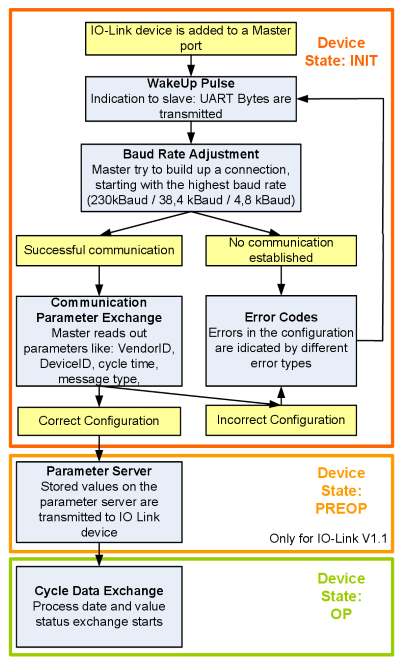 Fig.7: Establishment of IO Link communication
- If an IO-Link device is connected to a master port, the master attempts to establish communication. A defined signal level, the wake-up pulse, signals to the device that UART bytes are to be sent from now on.
From this point on, all data will be interpreted by the IO-Link device as UART bytes. - The master runs through all baud rates, starting with the fastest baud rate (COM3 = 230 kbaud). A successful connection has been established when the slave responds to the wake-up pulse.
- First of all the master reads the basic parameters (Vendor ID, Device ID, process data length, telegram type and cycle time) and compares them with the existing configuration.
- If no connection could be established to the device, or if the saved parameters differ from those read, the corresponding error is output.
- If the saved parameters differ from those read, the IO-Link device changes to the PREOP state.
If the IO-Link device specification is V1.1, the parameter server is now executed. If the IO-Link device specification is V1.0, this step is omitted and the device changes directly to OP. - Finally the cycle time is written and the device changes to OP. After that the master cyclically exchanges data with the device.