Use of the DTX1800/DSX5000
 | Changing the settings A product from a third party manufacturer is described in the following chapter. The respective operating manual is to be given priority. The data given below for the measuring device settings were valid at the time of preparing this documentation – it is possible, however, that the manufacturer of the measuring device may have changed the firmware/program user interface at short notice.The notes below should be considered to be supplementary to the manufacturer’s own operating manual. |
The use of the FLUKE DTX1800 for the certification of Ethernet transmission links is described below as an example.
Measuring
- Connect the main and remote device with the cable section
- channel adaptor DTX-CHA001A or
- patch adaptor DTX-PC5ES recommended
- switch both on; charge up beforehand if necessary or operate with the power supply units
- Selector switch to AutoTest
- Press Test
- Save after the test if necessary
Changing the settings
- Selector switch to Setup
- Change settings, e.g. test limit, see manufacturer documentation
- Selector switch to AutoTest
Measuring the irradiation
- Connect the main and remote device with the cable section
- switch both on; charge up beforehand if necessary or operate with the power supply units
- Selector switch to Monitor
- irradiations on the section can now be observed
The successor device DSX-5000 should be used accordingly.
4 dB rule/ 4 dB rule for NEXT/ACR
It can sometimes be observed that a section is declared as a PASS, although there is obviously a LIMIT violation for NEXT (or its ACR and PS).
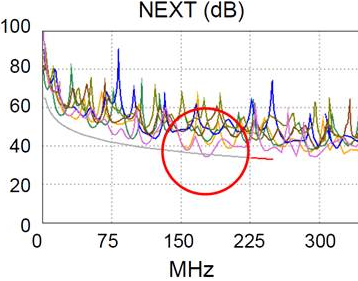 Fig.37: Evaluation NEXT/ACR from 4 dB insertion loss
The reason for this could be the 4 dB rule. This is contained only in tests according to ISO11801/EN50173; this rule is not known to TIA.
The wording of this rule is as follows: NEXT/ACR is not evaluated as long as the insertion loss of the section is < 4 dB. For identification the limit line is shown in black as long as the insertion loss is < 4 dB. Only if it exceeds 4 dB is the limit line coloured red and referred to for PASS/FAIL.
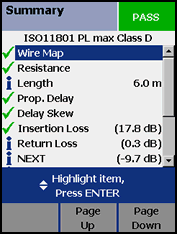 Fig.38: NEXT measured value indicated as “I” (informatively)
The NEXT measured value is only indicated informatively “i”. Refer also to the Fluke Knowledge Base http://www.flukenetworks.com/knowledge-base
Recommendation:
- Agreement should be reached for the specific project as to whether certification is to take place according to TIA or ISO/EN, i.e. without or with the 4 dB rule,
- NEXT/crosstalk is a functionally relevant section property. Since it is technically possible to create sections that do not violate NEXT, a measurement without the 4 dB rule can be useful.
3 dB rule for return loss
In same way as with the above 4 dB rule, return loss violations are also ignored as long as the insertion loss is < 3 dB (frequency dependent). This applies to TIA, ISO and EN tests.